As autumn temperatures drop, the last thing you want on a chilly morning is to adjust your thermostat, only to find your heater blowing cold air. The worst time to discover an issue is during a major freeze when you need heat most. In the middle of a winter cold snap, local contractors often face a massive backlog of service calls, making it difficult to secure prompt heating system repairs or routine maintenance.
Scheduling a furnace tune-up in early autumn allows you to catch minor ignition, electrical, or airflow issues before they escalate into major system breakdowns. By taking a proactive approach to professional HVAC maintenance, you preserve your equipment’s operating efficiency, lower monthly utility bills, and prevent your family from being left out in the cold.
Key Takeaways:
- Testing your furnace early in autumn allows you to catch and resolve potential operational issues before winter freeze locks in high demand and emergency repair rates.
- Running a full diagnostic test run helps confirm that the system safely executes its entire ignition sequence and delivers consistent warmth across your home.
- Recognizing major red flags—such as short cycling, persistent cold air, or unusual sounds and odors—signals an urgent need for professional repairs before complete system failure occurs.
- Long-term indicators like aging equipment, rising utility bills, and frequent maintenance calls suggest your furnace may be nearing the end of its reliable lifespan.
- Replacing your air filter with the proper MERV rating is essential for maximizing airflow, lowering energy costs, and preventing internal system overheating.
- Following a thorough pre-winter maintenance checklist and scheduling a professional HVAC tune-up ensures reliable home comfort and optimal efficiency all season long.
Note on System Compatibility: Home heating systems vary. This guide specifically focuses on forced-air gas furnaces, which rely on fuel ignition, burners, and safety controls to heat your home.
When Should I Test My Furnace Before Winter?
While peak heating demand typically stretches from December through February, waiting for the first severe freeze to fire up your system is a risky gamble. The optimal window for a preseason diagnostic run is early to mid-autumn—ideally between late September and late October—before ambient outdoor temperatures drop consistently into the freezing zone.
Initiating a trial run weeks before daily operation becomes essential establishes a critical operational safety margin. Identifying a failing igniter, a faulty limit switch, or restricted airflow during off-peak autumn months allows you to book a routine HVAC inspection and source replacement parts at standard rates.
Testing early guarantees you avoid midwinter service backlogs, freezing indoor temperatures, and the steep premium of after-hours emergency repairs.
How Do You Test Your Gas Furnace to Ensure It’s Ready for Cold Weather?
Follow this simple, step-by-step test run procedure before the first major cold front hits:
Step #1: Set your thermostat to Heat mode for an initial baseline check.
Switch your thermostat setting from “Cool” or “Off” to “Heat.” Set the target temperature 3 to 5 degrees above the current room temperature so the system immediately calls for heat.
Step #2: Listen for startup sequence.
Stand near your furnace or thermostat and listen carefully. You should hear the draft inducer fan turn on, followed by ignition (a click or spark), and finally the main blower motor kicking on to push warm air through the ductwork.
Step #3: Check airflow at supply vents to test the temperature.
Walk through your home and feel the air coming from the supply registers. Within 3 to 5 minutes, the air coming out should feel consistently warm and circulate evenly across every room.
Step #4: Observe a full heating cycle and verify proper shutdown.
Let the system run until it reaches your desired set temperature on the thermostat. Verify that the system shuts off smoothly without short cycling or continuously running.
Signs Your Furnace Might Not Make It Through Winter
Even if your furnace successfully turns on today, subtle performance warning signs suggest it is at high risk for a complete midwinter breakdown:
- System Age Over 15–20 Years: The average gas furnace lifespan is 15 to 20 years. Older units lose heating efficiency and suffer critical component failures under heavy winter loads.
- Unexplained Spike in Energy Bills: A sudden jump in your monthly gas or electric bill indicates that the system is consuming excess power to produce basic household heat.
- Uneven Heating Across Rooms: Cold spots in specific bedrooms or upstairs zones indicate declining blower capacity or severe ductwork airflow restrictions.
- Frequent Repair History in Recent Years: If you’ve had to call a technician multiple winters in a row, the cumulative wear and tear means major parts are reaching end-of-life.
Ready for a quote?
Click below to leave your information and we will call you back in 30 minutes or less!
Leave your information below and we will call you in 30 minutes or less.
*During normal business hours. After hours calls will be returned the next business day.
Signs You Should Schedule Maintenance or Repairs Now
If you notice any of the following immediate red flags during your pre-winter test run, do not wait for cold weather to set in—schedule a repair or inspection right away:
- Furnace Blowing Cold or Lukewarm Air: If the air coming from your vents never gets hot, you could be dealing with a faulty igniter, pilot light failure, flame sensor issue, or clogged gas line.
- Rapid Short Cycling or Sudden Shutdown: If your furnace turns on, runs for 30 to 60 seconds, and then shuts off abruptly, the system is overheating or experiencing a limit switch trip. On high-efficiency condensing furnaces (90%+ AFUE), this is also frequently caused by a clogged condensate drain trap or line, which trips the safety float switch to prevent water damage.
- Persistent Unusual Noises: Loud banging, screeching, or grinding sounds upon startup often point to loose belt drives, failing motor bearings, or cracked heat exchangers.
- Pungent Gas or Electrical Odors: A faint “burning dust” smell during the first 15 minutes of startup is normal as dust burns off burners. However, a persistent sulfur/rotten egg odor (gas leak) or sharp burning plastic smell requires immediate attention.
>> Heat not working? Find out what might be wrong with your furnace and what to do next.
Should You Change Your Furnace Filter Before Winter?
Yes, absolutely. Installing a fresh, clean furnace filter is the single most effective task a homeowner can do before the heating season begins.
Why a Fresh Filter Makes Life Easier for Your Furnace:
- Restores Optimal Airflow: A dirt-clogged air filter restricts incoming air, forcing your blower motor to work twice as hard to circulate heat.
- Prevents Overheating: Poor airflow starves the heat exchanger of cool air, causing internal temperatures to skyrocket and triggering safety system shutdowns.
- Lowers Monthly Utility Bills: Clean filters allow your furnace to run shorter, more efficient heating cycles, directly reducing energy consumption.
- Protects Indoor Air Quality: Trapping dust, pet dander, and allergens keeps air clean during winter months when doors and windows stay closed tight.
Note on MERV Ratings: Choose a filter rated between MERV 8 and MERV 11 for standard residential furnaces. Filters rated MERV 13 or higher trap smaller particles but significantly restrict airflow on most home systems, which can mimic a clogged filter, cause overheating, and trigger safety shutdowns. Check your manufacturer guidelines to confirm the maximum MERV rating your blower can handle.
Furnace Winterization Checklist
Here is a quick checklist of simple, safe maintenance tasks every homeowner should complete every autumn:
- Replace the HVAC air filter (select the correct MERV rating for your system).
- Clear supply registers and return air vents from furniture, rugs, or drapes blocking airflow.
- Inspect and clean around the unit—keep at least 3 feet of clear space around your furnace, free of boxes, paint cans, or flammable items.
- Check intake and exhaust vent pipes on exterior walls to ensure they are free of leaves, bird nests, or debris.
- Test carbon monoxide detectors and smoke alarms, replacing batteries in every detector across all levels of your home.
- Inspect the thermostat, replacing old batteries and setting your automated winter temperature schedule.
FAQs About Getting Your Furnace Ready for Winter
What specific tasks does a certified technician perform during a professional tune-up that a homeowner cannot do systematically?
While homeowners handle surface maintenance—such as replacing air filters and clearing supply vents—a certified HVAC technician performs deep-level diagnostics, cleaning, and technical calibrations required to ensure safe combustion:
- Combustion & Fuel Analysis: Testing manifold gas pressure, verifying proper fuel-to-air mixture, and inspecting burner flame stability.
- Safety Switch Diagnostics: Electrically testing critical safety mechanisms like flame sensors, high-limit switches, and draft inducer pressure switches.
- Heat Exchanger Inspection: Conducting camera or dye tests to check the heat exchanger for hairline fractures that could leak carbon monoxide.
- Electrical & Component Servicing: Measuring motor voltage and amp draw, inspecting relay controls, tightening all high-voltage wiring, and cleaning the blower wheel.
How long does a standard pre-winter HVAC inspection and maintenance service take?
A thorough, professional tune-up for a standard residential gas furnace typically takes 45 to 90 minutes.
The duration can vary depending on several operational factors:
- Access Location: Units located in cramped attics or tight crawl spaces require more setup and tear-down time.
- System Age & Condition: Older systems with heavy dust accumulation on the blower assembly or burners require extra cleaning.
- Additional Equipment: Connected accessories—such as whole-home humidifiers, electronic air cleaners, or multi-zone damper systems—add approximately 15 to 30 minutes to the service visit.
How often should I replace my furnace air filter during the peak winter heating months?
Filter replacement intervals depend on filter thickness and household conditions:
Filter Type & Thickness | Standard Replacement Interval | High-Demand Winter Interval |
1-inch Pleated Filters | Every 30 to 60 days | Every 30 days |
4-inch to 5-inch Media Filters | Every 6 to 12 months | Every 6 months |
Note: Check your filter every 30 days during peak heating months if you have pets, live in a high-dust area, or use your furnace continuously. Heavy dust loading starves the system of return air and triggers premature thermal shutdowns.
Why is testing or replacing carbon monoxide detector batteries specifically highlighted alongside furnace maintenance?
Gas furnaces generate carbon monoxide (CO)—a colorless, odorless, and tasteless toxic gas—as a natural byproduct of fuel combustion. Under normal operating conditions, these exhaust gases are safely vented outside through the flue pipe.
However, system failures like a cracked heat exchanger, a blocked flue vent, or incomplete gas combustion can release CO directly into your living spaces. Because carbon monoxide poisoning cannot be detected by human senses alone, maintaining functional, battery-backed CO detectors on every level of your home serves as your critical safety net if a heat exchanger fails mid-season.
Is it safe to leave a furnace running continuously if I go away on vacation during the winter?
Yes, it is essential to leave your furnace running while you are away during the winter. Shutting the system off completely allows indoor temperatures to drop below freezing, putting household plumbing at severe risk of bursting and causing major water damage.
To balance freeze protection with energy efficiency while away:
- Set Back the Thermostat: Keep the indoor target temperature between 55°F and 60°F (13°C to 15°C).
- Replace the Filter: Install a fresh air filter right before departing to prevent airflow blockage while unattended.
- Open Interior Doors: Leave bedroom and utility room doors open so warm air circulates evenly to exterior wall plumbing.
- Fresh Batteries: Ensure your thermostat and carbon monoxide detectors have fresh batteries installed before leaving.
Is a pre-winter furnace tune-up worth the money?
Yes, in many cases, timely furnace maintenance will pay for itself. A professional furnace tune-up easily pays for itself by reducing monthly heating costs and preventing more serious furnace repairs:
- Lowers Monthly Energy Bills by 5% to 15%: Clean burners, calibrated gas valves, and fresh air filters allow your furnace to operate at peak thermodynamic efficiency. The U.S. Department of Energy estimates that routine annual heating maintenance cuts monthly energy usage by up to 15%.
- Prevents $400+ Emergency Service Fees: The majority of furnace breakdowns happen during extreme cold snaps when systems run continuously. Emergency repair calls on evenings, weekends, or holidays routinely incur $400 or more in base call-out fees and overtime labor rates. Catching failing igniters, worn bearings, or dirty flame sensors during an autumn checkup eliminates these emergency premiums.
- Extends Operating Lifespan: Preventing cumulative component strain helps your system reach its full 15-to-20-year lifespan, delaying a replacement cost of $4,000 to $8,000+.
How do I know if my heat pump or electric furnace is ready for winter?
While this guide focuses on gas furnaces, heat pumps and electric resistance furnaces also require pre-winter preparation. To ensure your electric system is ready:
- Test Heating & Auxiliary Modes: Switch your thermostat to Heat mode and set it 3°F above room temperature. For heat pumps, verify that warm air flows from vents without triggering “Auxiliary/Emergency Heat” right away.
- Inspect the Outdoor Unit (Heat Pumps): Clear leaves, snow, and debris from around the outdoor coil to maintain proper airflow and prevent ice buildup during defrost cycles.
- Check the Air Filter & Registers: Electric heating elements rely heavily on unrestricted airflow. A dirty filter or blocked supply vent can cause heating coils to overheat and trip safety thermal limiters.
- Listen for Defrost & Blower Cycles: Heat pumps periodically enter a brief defrost cycle in cold weather, which may produce a momentary reversing valve “whoosh” sound and brief steam—this is normal. However, loud grinding, rattling, or continuous auxiliary heat operation signals a failing compressor or reversing valve that requires professional inspection.
Our technicians have extensive experience with electric furnaces and heat pumps, as well as gas furnaces, so if you have questions, don’t hesitate to give us a call to schedule an inspection for your unit.
Call Us Today to Schedule a Winter Checkup for Your Furnace!
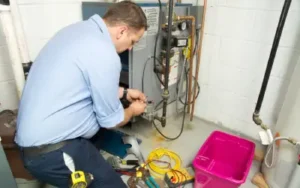
Don’t leave your family’s comfort to chance when cold weather arrives. Catching minor wear and tear, loose electrical connections, or dirty burner assemblies now will protect your system from severe damage, extend its operating life, and save you money on monthly heating costs all season long.
Our certified HVAC technicians perform comprehensive pre-winter safety inspections and precision tune-ups and maintenance to give you complete peace of mind. We inspect heat exchangers for dangerous cracks, test safety controls, clean burner assemblies, calibrate your thermostat, and ensure optimal fuel efficiency before winter hits.
Be ready before the first big freeze. Call our friendly team today to schedule your preseason furnace inspection online to lock in your priority appointment!
